
Aller au contenu principal

A Journey of Inner Transformation and Conscious Leadership

Datum

Dr. Jaya Parekh, Principal, Delhi Public School, Pune, India

My fourteen-year association with ETST has influenced my understanding of the deeper purpose of education and has shaped me not only as an educator and school leader but, more importantly, as a human being. I began my journey with ETST as a participant in its workshops, unaware at that time that this platform would become a compass for my personal and professional life. Over the years, as I transitioned into being a core team member, ETST evolved from being an organization I engaged with to becoming a value system I lived by. The learning I absorbed through ETST— deeply rooted in the philosophies and practices of IofC — has steadily transformed my thinking, my leadership style, and my approach to education.

One of the most powerful gifts ETST has given me is the practice of Quiet Time. In a world that constantly demands speed, reaction, and noise, quiet time taught me the courage to pause. This pause is not passive; it is deeply active and reflective. It is in this silence that I learned to listen—to my inner voice and to other points of view. Decisions taken after reflection, rather than reaction, tend to be wiser, calmer, and more inclusive.

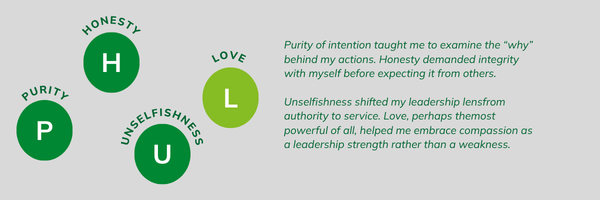
Closely intertwined with this practice is the practice of measuring one’s life against the absolute standards of PHUL These are not abstract ideals; through ETST, they became lived values.
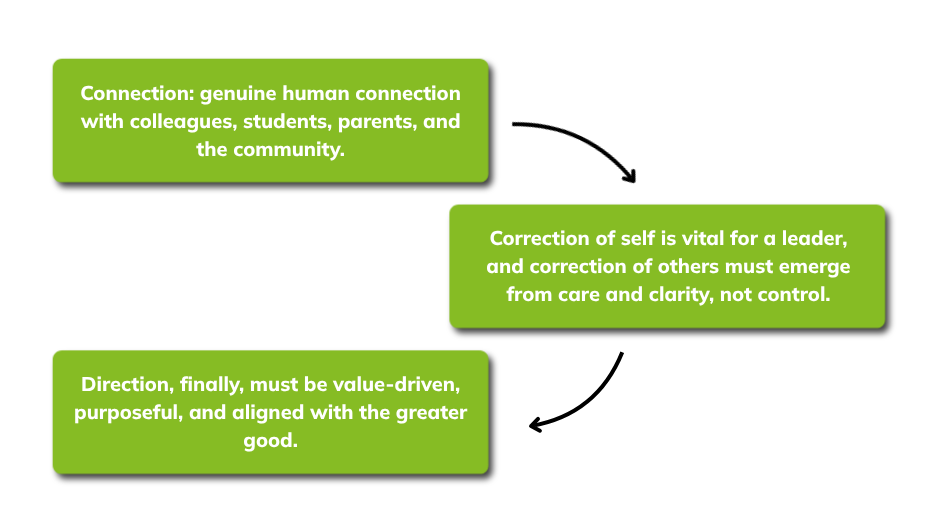
Equally impactful has been the framework of CCD—Connection, Correction, and Direction. ETST helped me understand that meaningful leadership begins with:
As an educationist, these learnings translated into tangible practices across the schools I have served—earlier at Ram Ratna International School, Mumbai, and currently at Delhi Public School, Pune. ETST’s influence is visible not only in policies or programmes but in the culture we consciously nurture. One such adaptation is the practice of Quiet Time in the form of Alpaviram in our schools. Introduced thoughtfully and age-appropriately, Alpaviram allows children to experience silence, reflect, and connect with their inner voice. From a young age, students begin to understand the difference between impulsive mental chatter and intuitive inner guidance—a life skill that textbooks alone cannot teach. Gratitude and forgiveness, values strongly emphasized through ETST, have also found a structured place in our school culture. Practices like Thank You Thursday, dedicated to cultivating gratitude, and Forgiveness Friday, which encourages reflection, empathy, and reconciliation, have become part of our daily routine.


My association with ETST inspired me to make empathetic service to society an integral part of school life. Community-oriented programmes that initially felt ambitious, even intimidating such as Khushi Bazar, Khushi Utsav, and Coins for the Country emerged from this inspiration. These programmes were designed not merely as events but as experiential learning opportunities— helping students understand dignity of labour, social responsibility, and the joy of giving. One of the most transformative steps in this direction was the adoption of a tribal village by our school. Through this initiative, our students, teachers, and parents experienced firsthand what it means to serve with humility, consistency, and respect—moving away from charity towards partnership.

“ETST has also played a crucial role in shaping me as an ethical and emotionally intelligent leader.”

Through its workshops and shared stories of transformation, I learned the power of non-violent communication, empathetic listening, and inclusive dialogue. ETST reinforced the idea that leadership is not about having all the answers, but about creating safe spaces for honest conversations and collective growth. It reminded me that leadership credibility comes not from position alone, but from authenticity and continuous self-improvement.

Over the years, I have witnessed the ripple effect of these values—how they permeate staff culture, student behaviour, parent engagement, and community relationships. Teachers become more reflective practitioners, students more empathetic individuals, and parents more aligned partners in education. These outcomes reaffirm my belief that when educators work on themselves, institutions transform organically.

ETST gave me the courage to overcome inhibitions and fears, to step beyond comfort zones, and to trust that meaningful change often begins with small, consistent actions. Education today truly shapes society tomorrow.